Showing posts with label Brush Fire. Show all posts

Saturday, August 10, 2013

Dilbert and the Fire Department

The cartoon “Dilbert” wouldn’t be so funny if it weren’t so situationally accurate which long ago led me to develop one of “Ryman’s Rules” relating to the strip. This one is not a law of physics, but a sociological paradigm which states that: Morale of any organization is inversely proportional to the number of Dilbert cartoons hanging on the walls.  With that in mind, how many of these comic strip worthy situations have you seen or experienced?

Pulling into a fire scene with an assignment to lay a supply lie and finding the hose bed empty, the line having accidentally laid during the response.  Funny how that never happened when we rode the back step; oh well.
Watching a hose bed turn into silly string when the pump operator charges the wrong line—the one not pulled.
Getting ready to drain the drop tank and finding the drain placed on the uphill side. 
Extending the “blue line” with yellow hose and handing it to a new crew who then asks for the “yellow line” to be charged. The reason I hate color coded lines.
Scanning mobile and portable radios—the important information always gets cut off. Enough said.
Pump operators who think “100 pounds is good enough for everything.”
Did you ever notice the same five guys who always have to leave for work the minute it’s time to wash the rigs and hose after a run?
The company responding for RIT that calls out with five and shows up with a driver and four juniors. 
The officer, who when in charge of a training night, waits until everyone arrives and then says “so what do you guys want to do tonight?”
Fire Police who drive like Jeff Gordon for some reason assuming it is critical they be the first on scene—in order to direct traffic. 
The citizen who on an annual basis, waits for the windiest day of the year to burn trash, resulting in a 5 acre brush fire, and then acts surprised when he gets yelled at. 
Looking at the personal vehicles parked during the inevitable call on the afternoon of the first day of buck season and marveling that there is more firepower present than that possessed by the entire local police department. Actually true most any day for rural departments.
The local cop who on an automatic fire alarm offers to shoot the lock off the door instead of waiting for the apparatus or key holder.  His offer was turned down.
The guy with more state class patches on his sleeve than a Sergeant Major has stripes—who won’t go inside. 
The guy with the two door subcompact car and a blue light bar so big it extends feet beyond the sides of the car. So big you wonder if the car will rotate when the lights are turned on.
The guy who carries three pagers and two portable radios—all on his belt at the same time. Note: The three above are often the same guy. 
The brush fire in a two acre field with only a single solitary tree located right in the center—which the brush truck driver hits while backing up.    
You know you’re really in trouble when three pieces of apparatus, all responding to the same call, reach the same intersection; and one turns left, one goes straight, and the third turns right.
Last, but certainly not least, (insert favorite personal activity here) with your significant other is invariably interrupted by the pager.

Sunday, December 16, 2012

Backyard "Training" or...What the Burn Barrel Can Teach

The ubiquitous burn barrel isn’t just the source of springtime brush fires when oblivious residents decide to light them when the wind is gusting at forty—so much so that it probably took them five matches to get the stuff going.  It can actually be an opportunity to turn the mundane task of burning trash into a learning experience. 
The backyard burn barrel can be a firefighter’s small scale research lab for fire behavior.  Vertical and horizontal spread and smoke development can all be “studied” in an admittedly limited but still beneficial way while completing a line on the honey-do list.  Try to extrapolate in your mind how these materials, put in a room, would similarly react to this small ignition source.  Notice how the physical configuration; vertical or horizontal, affects the speed of development.  The differences observed from ordinary combustibles when the occasional piece of plastic sneaks into the barrel by “accident” is telling as well. 

An unusual method?  Maybe, but don’t waste a single opportunity to learn from a fire.  The routine job of disposing of papers and boxes can be your own mini training session on fire behavior. 

Sunday, July 1, 2012

A Sarcastic History of Portable Radios

I have seen an evolution in portable radios which goes from the Paleozoic to Bill Gates.  One of the first portable radios I ever used was a single channel RCA model about the size of a squished loaf of bread, but weighing considerably more.    Unless you had hands the size of a linebacker, it took two to actually use the thing; one to hold it and the other to key the transmit button.  The next generation was a four channel Motorola, two of which we didn’t need, slightly bigger than a brick and about the same weight.   They were damn good radios that took a licking and kept on ticking.  Extension microphones came next which put the most important parts of the radio on your collar, the speaker and the mic itself.  All you had to do is turn your head, mash the button on the side and talk. 

Initially, only Chief’s had portables, then company officers, and now everyone.  The rapid expansion in radio availability turned the fire ground from a nice quiet, pleasant place, into a cacophony of noise, squeals, screamers, and those that loved the sound of their own voice.  Eventually, most places establish communications policies that reined in the worst offenders, but you can still hear the white noise in some areas. 

Interoperability became the next buzz word, with the so called need to be able to talk to the world, and as the size of radios decreased, the channel capacity increased until the hundred channel radio became ubiquitous.  Most of these units would live, die, and be replaced with the next latest and greatest model without ever having used more than ten percent of the channels they contained, but it was critical to have the secondary fire police channel of some department three counties away that you had never, in the history of the department, ever run with. 

Now the radios will talk to you, Siri-like, although they won’t answer questions –yet, or tell you where to get a good pizza on the way back to the station (hint, hint Mr. Motorola—just kidding).  The radio lady, Sophie I’ll call her, tells you what channel you’re on.  Good thing, cause it’s not like I can remember who or what is on channel 63. 

The extension mics have started to grow also, and now are almost as big as the radios they are attached to.  Speaker and mic button aren’t enough now; volume controls and a mayday alert, all of which supposedly can be worked by gloved hands in the dark.  Good luck.  Makes me wonder why we need the extension mics anymore—just attach the radio to the collar.

Technology is a wonderful thing, but the complexity has reached the level that I pine for the days when you didn’t need an electrical engineering degree to use a portable.   Maybe, just maybe,  RCA will start making radios again. 

Wednesday, April 11, 2012

Indian Tanks and the Big Bang


The spring brush fire season, a particularly nasty one this year in northeastern and central Pennsylvania, brings thoughts to one of the most important of “Ryman’s Rules.” It’s actually not a rule—not part of the philosophy of managing firefighters. It is actually a theory or law of physics; something for the Big Bang boys to debate.

The theory or law goes like this: Water weight in an Indian Tank increases one pound per gallon for every year you are over forty.

For more years than I will admit, I have found this to be true, hence my long standing position, both physically and metaphorically, anywhere which does not include the necessity of wearing said Indian Tank.

Let the debate begin…..

Sunday, November 6, 2011

Brush Fire Surprise

One of the first brush fires Mike went on when he was a fourteen year old cadet held an interesting surprise. The fire was just over the line in Greenfield, but both companies were working it. I was not—following my personal rule against Indian tanks based on “Ryman’s Law,” my contribution to the world of physics, which states that water weight in an Indian tank increases one pound per gallon for ever year over forty. Observing and functioning as a quasi safety officer—mainly for my son, was perfectly fine by me.

Mike had donned his Indian tank and was working the perimeter, mindful of my admonitions to stay in the black as he knocked down flames at the head of the fire. Concentrating on the fire, he didn’t see an unusual visitor until feeling something unusual at boot level. He looked down to see a copperhead crawl over the toe and ankle of one of his rubber bunker boots and continue slithering away. A few squirts from the Indian tank encouraged the snake to continue and perhaps expedite its journey elsewhere, location unknown, as Mike certainly didn’t go looking for him. It was certainly an interesting way for him to learn that fires are always full or surprises.

Monday, October 3, 2011

Beautiful Fall Leaves

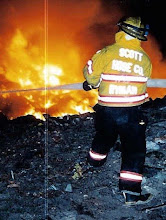
The changing of the season and the leaves falling from the trees reminded me of an experience I had years ago. Initially it came in as a small brush fire. The middle of the night dispatch was accurate as far as it went. I rode the left well of the wagon as we made our way down New Hampshire Avenue, the siren needed only infrequently at this hour with little traffic to impede us.

As we made the left hand turn onto the side street, I could see the column of flames in the air. Not typically what you see from a brush fire, but it was obviously coming from the wooded section near the edge of the neighborhood, so I didn’t think much of it. Another left onto the dead end roadway, and we were there.

There was definitely a brush fire. Unfortunately, the center of the burning brush and leaves included a van, fully involved. At least the column of fire in the night sky was now explained.

I dismounted and grabbed the nozzle of the inch and a half trash line from the running board, and started making the stretch toward the fire. Paulie, one of the career guys, flaked the line out behind me. The driver put the pump in gear and charged the line. I opened the nozzle and moved in toward the burning van, killing the burning brush in front of us as I went.

Reaching the van, I directed the nozzle into the interior, sweeping the stream across the ceiling then whipping the nob around. The fire darkened and seemingly went out inside the vehicle, but looking down, it was now shooting out from under the van onto my boots and lower legs. It got my attention.

Backing up a couple of feet, I swept the underside of the van with the stream. Now the fire flared back up inside the vehicle. Paulie left to go back to the Engine and pull another line, while I continued playing ping pong with the fire.

He returned with the second hose and we worked the brush and van together. Moving toward the engine compartment, the stream hit one of the vans front wheels. Bright beautiful colored flames came off of it.

“Shit,” Paulie and I said simultaneously. It was magnesium, which was a bitch to put out with water. You typically used sand or a special extinguisher. We didn’t have either this night.

I looked behind me and saw that the engine officer, Lieutenant F, had seen the same thing. He had a length of three inch on his shoulder and the Humat valve in his hand as he humped toward the nearest hydrant. He knew the tank water alone on the Engine wasn’t going to cut it.

Paulie and I kept working the lines. We were trying to keep the fire underneath the van knocked down and away from the gas tank. The hydrant supply established, the lieutenant supervised and moved from line to line behind us. He was an old fashioned officer. No way was he calling for help for a small brush fire.

We attacked from two directions, hoping to end the table tennis match with the fire. I kept pushing it away from the gas tank while Paulie knocked it down in the van again. He could tell the gas tank made me nervous. I knew they seldom caused problems, but they also weren’t typically exposed to fire for this long.

“Don’t worry kid. If that tank goes we’ll be frigging heroes, and we won’t feel a thing,” Paulie laughed.

It lightened the mood, which was his purpose. Slowly we got control, and with the coarse straight stream, were even able to put out the mag wheels.

Then came the drudgery; draining and re-racking the hose. The sun began to rise by the time we were done. Back at the station, I collapsed into my bunk for a half hour or so until the day shift crew came in. Just the routine noise they made ruled out further sleep. Good thing I was only twenty and didn’t require much rest.

Yeah, the colorful fall leaves are a wonderful thing.