Showing posts with label Firefighting. Show all posts

Friday, August 31, 2012

Recent interview by author Pat Bertram

Gary Ryman, Author of “Fire Men: Stories From Three Generations of a Firefighting Family”


What is your book about?
Fire Men: Stories From Three Generations of a Firefighting Family relates the experiences as firefighters of my father, myself, and my son. As both the son and father of firefighters, I bring a different perspective. Having the opportunity to fire fires, with both my father and my son as well as respond to auto accidents, and the myriad other emergencies that fire departments handle was marvelous.

How long had the idea of your book been developing before you began to write the story?
I can’t say it really started in my mind as a book. I began writing out the stories of individual emergency calls with the thought that perhaps sometime in the future the vignettes might be of interest to my son or daughter or perhaps a future generation. After I had a hundred plus pages of this material, it dawned on me that perhaps this was a book trying to get out.

How long did it take you to write your book?
About four years from pen touching paper to holding the first printed copy. The first draft took just over a year. It wasn’t remotely ready, but I didn’t know that at the time, and with the encouragement of some friends, I began the querying process. One of the agents I wrote had represented an author I liked a great deal. A few weeks after sending my letter, I received an email from another agent at that firm indicating that the first agent was not interested; but that my query had intrigued her and she wanted to read the manuscript. After reading it, she agreed to work with me and provided incredibly valuable feedback and suggestions which I incorporated in a second draft. A few more rounds of revisions followed and just before she was ready to start sending the manuscript out, I was orphaned—she left to take a job as an editor at one of the big six houses. Not surprisingly, the agent she passed the manuscript who decided it wasn’t for him, and so I was back to square one, albeit with a much improved book. This time, along with agents, I looked at small publishers as well, and was lucky enough to hook up with a wonderful publisher, Tribute Books http://www.tribute-books.com/ They have since transitioned to YA books, but continue to strongly support their entire list, and have been just fantastic to work with.

What is your goal for the book, ie: what do you want people to take with them after they finish reading the story?
For many, whom the closest they have ever been to a fire truck is when it passes them on the roadway, I hope they get an understanding of what firefighting is really like. The mental and physical challenges, along with the emotional aspects of the job are not usually apparent to the general public. In addition to those, the family facets lend an important component. While I worked with my father and son, I also had many brothers; fellow firefighters who you trust with your life. For those in the fire service, the greatest compliments I receive are those that read it and say “yeah, that’s exactly how it is.”

What are you working on right now?
I just submitted my thesis for my Masters in American History. That has been consuming me for most of the past nine months. Now I hope to return to the novel I began shortly after publication of “Fire Men” which is an action adventure genre work, naturally set in a fire department. A Lieutenant dies while battling a fire which was deliberately set in an insurance fraud scheme and his best friend and brother-in-law who leads a ladder company in the same department searches for the arsonist.

What do you like to read?
I read mainly history or action/adventure.

Where do you get the names for your characters?
When I wrote the book, I used real names to allow me to keep track of people and try to ensure I captured their personalities. In the revision process, though, the majority of the names had to be changed. I stole an idea from a writer’s seminar I attended, and bought a baby name book, and reworked the names from that.

If your book was made into a TV series or Movie, what actors would you like to see playing your characters?
While I can’t say for everyone in the book, I would certainly be willing to settle for being played by Brad Pitt. The resemblance (not) is so close!

Who designed your cover?
The publisher took care of the cover, and I think did an incredible job. I was stunned the first time I saw it, and could not have been happier.

Where can people learn more about your books?
Folks can visit my website for more information. The book is also available in paperback on Amazon.com as well as Barnes & Noble and in virtually all e-book formats.
http://fire-men-book.blogspot.com/
http://www.amazon.com/gp/product/0982256590/ref=s9_simh_gw_p14_d0_i1?pf_rd_m=ATVPDKIKX0DER&pf_rd_s=center-2&pf_rd_r=0CM4CBCA5H4DWQXT1Y38&pf_rd_t=101&pf_rd_p=1389517282&pf_rd_i=507846
http://www.barnesandnoble.com/w/fire-men-gary-r-ryman/1100719030?ean=9780982256596

http://patbertram.wordpress.com/2012/08/28/gary-ryman-author-of-fire-men-stories-from-three-generations-of-a-firefighting-family/#comment-2906
 

Sunday, August 19, 2012

The Continuum of Change: Residential Sprinklers vs the “Good” Fire


One sentence from a recent conversation continues to stick in my mind.  “If it weren’t for that sprinkler in the townhouse, we would’ve had a good fire.”  It was stated only partly in jest, the young firefighter, like many, always wanting more of the challenge of a “good” fire.  No one, save the psychotic, wants to see someone else’s property destroyed much less anyone injured; but this is juxtaposed with the firefighter’s inherent desire to perform their craft and test themselves in that environmental nightmare we call “inside.” 
We need a partial shift in balance to begin better educating the younger firefighters as to the desirability of residential sprinklers.  For the most part, their response to commercial sprinkler alarms and fires is something they accept as common and normal.  The expansion of residential sprinklers, however, is newer and something which reduces the size and number of their bread and butter—the house fire.  Understanding is one thing, but acceptance is another.  Sliding the scale so these aggressive young men and women buy into the importance and value of these systems is a critical leadership task. 
It is difficult to see, accept, and support technology which if (or hopefully when) it becomes widespread, can eliminate much of the reason many of us came into this business to begin with.  It’s like the people version of steam replacing the sail or the car replacing the horse; not gone, but much reduced.  Just the same, pushing for these systems over the construction industry lobbyists and their pocket politicians should be continued.  That, and educating the younger generation of firefighters— so they can succeed where we haven’t. 

Monday, August 6, 2012

My Wish List for the Next Generation of Firefighters

Communications integrated into the helmet and face piece.  The tinny speakers in masks never worked right and it’s ridiculous to try to talk through face pieces.  Extension microphones are actually getting bigger, not smaller, unlike every other piece of technology in the world.

An infrared heads up display in the face piece.  There are no reasons that every firefighter shouldn’t have a camera, and no reason you should have to carry the thing. 
Apparatus designs in which hose and equipment can be reached from the ground.  This isn’t so much reengineering as it is going retro.  When I started, you could reach the pre-connects in the rear from the ground, and standing on the tailboard, you could see the driver.  There is no reason we need ladders on apparatus to reach our own equipment.  You shouldn’t have to practically set up scaffolding to reload the hose bed. 
C’mon folks; we had guys walking around on the moon in 1969; there is no reason we can’t have these simple items on a cost effective, and importantly, firefighter proof configuration. 

Saturday, July 28, 2012

The Times Have Changed…Maybe Not


I recently came across a fascinating historical document.  The rules and regulations for the Los Angeles Fire Department from 1901 are, in many respects, not much different than those in place in many departments today, a century removed.  One major difference was apparatus propulsion, the turn of the century still being what we view as the romantic era of the horses.  Contrary to the opinion of the third generation, his father (me) and grandfather had no actual experience in the horse drawn days.  After reading the policies relating to the care for the diesel engines of the day, one wonders if the brothers then viewed them with the fond nostalgia we do.  The rules show the importance of the animals was paramount

RULE 13.
CARE OF HORSES, APPARATUS, HOSE, ETC.

SECTION 1. Horses shall be fed not more than four quarts of grain and about twenty pounds of hay daily, and twice a week shall be fed a bran mash.

SEC. 2. Hours for feeding horses shall be 6.30 A.M. and 4.00 P.M., and must be watered at least thirty minutes before feeding time.

SEC. 3. Horses shall be thoroughly groomed every morning, their hoofs picked out and cleaned, their manes and tails washed with soap and water once every week and thoroughly dried after washing; the sheath shall be washed every two weeks. Grey or white horses may have stains sponged off with warm water and soap, but must be thoroughly dried immediately. White legs may be washed in the same manner, otherwise the legs must never be washed. Washing horses is strictly forbidden, unless by permission of the Chief Engineer, and then only with bucket and sponge.

SEC. 4. On returning from an alarm, horses' mouths and nostrils must be sponged out, and may be given a few swallows of water, and, if warm, must be scraped, rubbed dry, and blanketed. Sweat should be removed from around the eyes and under the tail with a damp sponge. Horses must never be given grain while hot after a run or exercise.

SEC. 5. Teasing or annoying horses, or teaching them tricks is strictly forbidden.

SEC. 6. Horses shall be exercised daily within three blocks of the house, for a period of not less than one-half-hour, hitched to the apparatus (Sundays excepted). In wet weather the horses shall be exercised without the apparatus.

SEC. 7. A bucket must not be used to catch the horse's urine in, nor shall they be taught any like peculiarities. If a horse is staining to urinate, straw should be shaken under him. The stall should be washed out immediately and all manure must be removed immediately.

SEC. 8. If a horse is injured or shows signs of sickness the commanding officer of the company must be notified at once.

SEC. 9. Horses must be treated kindly, taught by kindness to come promptly to their place and perform their part of the service without the unnecessary use of the whip. The unnecessary use of a whip by any member will subject the offender to suspension or dismissal.

Morning check-out, washing rigs, changing fluids, filters, adding fuel, waxing (grooming); reporting mechanical problems or accidents—maybe things haven’t changed much after all. 
1901 LAFD Rules & Regulations

Friday, July 20, 2012

Upcoming TV Appearance

I will be appearing on PA Live on WBRE Channel 28 on Friday, July 27th with Dave Kuharchik and Monica Madeja to talk about "Fire Men:  Stories From Three Generations of a Firefighting Family." Tune in at 4:00 PM to watch!

Fire Men: Stories From Three Generations of a Firefighting Family

Saturday, July 7, 2012

Cats, Bats, and Stubbed Toes

We’ve all heard the stories of people visiting Emergency Rooms for stubbed toes—this is real—I have personally responded on an ambulance call for a person with a stubbed toe.  The fire department equivalent, again real, is the stereotypical cat stuck in the tree.  My father had the best response I’ve ever heard when the dispatcher would call with a report from a citizen of a feline atop a sapling.  “Tell the caller we’ve never seen a cat skeleton in a tree yet.  When the kitty gets hungry enough, it’ll come down.”  End of discussion.  Other animal control calls for squirrels or bats in houses get filed in this miscellaneous category. 

Less amusing was a recent incident I heard about where a citizen broke a fire truck windshield; literally beat a spider web of cracks in it with his bare hands, because the fire department couldn’t make his power come back on after a storm. 

What some members of the public fail to remember at times is that it costs money every time a fire truck turns a wheel.  Fuel, wear and tear, and indirect costs like insurance are all part of the equation every time a piece of apparatus moves.  That’s the mechanical side; more importantly there is wear and tear on people too.  Ill maintained and malfunctioning alarm systems are the bane of our existence.  No fine or penalty seems sufficient after the third straight night of a false alarm at the same place at 3:00 AM. 

The unnecessary, abusive, and downright strange calls continue to make up more than their fair share of any department’s call volume.  You have to go, though, ‘cause that’s what we do. 

Monday, July 2, 2012

The Final Count: 48 Hours From the Inland Hurricaine

The Maryland, DC, and Virginia area was pummelled by what some have decribed as an inland hurricaine.  Wind gusts to 90 miles an hour, and heavy rain fall combined to cause wide spread damage, power disruptions which may not be resolved for a week, and countless emegency runs.  The station where my son Michael lives in Montgomery County was in the midst of this, and in 48 hours, ran 52 calls.  Many were wires and trees down, automatic fire alarms, etc., but others were more serious.  These included

4 box alarms for structure fires
1 fatal wreck with one down the embankment and ejected
3 collapse calls for the squad
2 transfers to Howard county for the tower

All the above was in temperatures exceeding 100 degrees at times, and regularly in the high 90s.  Not exactly a "fun" weekend. 

Sunday, June 24, 2012

Micro Manager Metric Maniacs


The overwrought alliteration shows my disdain.  They are everywhere, but they use code words to describe themselves.  I’m “detail oriented” they say.  Never will one introduce themselves and say, “hi, I’m a micromanager.”   Their involvement in every aspect of operations is necessary, because no one can live up to their expectations. 

One chief who was an administrative nightmare to work for had many of these characteristics.   I called him a “shotgun manager.”  He never met an idea he didn’t like, so there were a hundred projects all in progress at the same time.  Because of this and the necessity for his involvement in everything—he couldn’t delegate to save his life—that meant that nothing ever was completed.  Since everything was a priority, nothing was.  Luckily, he wasn’t like this on the fire ground (fire ground micromanagers are even more scary) , and to this chief’s credit, he eventually evolved, changed, and improved, but that is the exception with this type of manager, not the rule. 

The data collectors are worse.  They never met a metric or measurement they didn’t like.  Just because an activity is quantifiable doesn’t mean it should be.  The argument is that the “workers” only do well what is checked—so these guys check everything.  When we measure everything, the same shotgun result occurs.  Since everything is a priority, nothing really is. 

My contention has long been there are typically four or five big important things that make an organization successful.  Measure and take good care of those, and everything else—the details—will take care of themselves.  I never thought it was rocket science, but maybe it is.  Einstein said “not everything that can be counted counts, and not everything that counts can be counted.” 

Thursday, May 24, 2012

"Old" Guy Stuff

Okay, this doesn’t go back to the horses, but if you experienced many of these (I did all of them), then you might be a “seasoned” firefighter if……


  • You rode the back step (and put you gear on while doing it) Only once…..that was scary…and stupid.

  • Rode an engine from which you could actually see the driver from the back step.

  • Wore ¾ boots inside

  • Wore a Scott I with no bell

  • Wore “red ball” gloves.

  • Know what a Plectron is—and had one—with tubes.

  • Remember using the 10-codes.

  • Wore a cotton duck coat.

  • Remember the introduction of “safety straps” for the back step.

  • Taken a 2 ½ inside. Something that should still be done, but isn't much.

  • Cut off a pair of leaky ¾ boots for your first set of bunker pants.

Sunday, November 20, 2011

If We Bought Our Personal Cars Like We Buy Fire Apparatus...

I have mentioned previously the excessive interlocks and safeties increasing the now astronomical cost of fire apparatus. This, however, is only part of the problem. In the other portion, we are our own worst enemy.

A military term for it is gold plating. Disingenuously, we call it meeting our needs. Custom hose bed arrangements, specialized compartments, light packages rivaling the Radio City Christmas tree, and that is before we get to pumps and tanks. “Custom” engines costing in the $400,000 range are unsustainable for all but a very few departments.

This picture makes me think about what it would be like if we purchased our personal cars using the same methods we use for fire apparatus. The typical sedan, SUV, or pick-up has three levels; a basic, intermediate, and luxury level. Each step up seems to add a half dozen options, but it’s not an ala carte menu. As bad as new car costs are, I can see what would happen…..

Chief B enters the local Ford dealership.
“I’d like to spec out one of those new Taurus’s you have,” the Chief says.

“Great Chief, step right over to my desk.”

“I like your base model, but I need a special trunk, as I only load my suitcases one way.”

“Can do, Chief.”

“Also, I need four head lights instead of two, and these special brake lights. The hazard flashers will have to be moved because of the special trunk.”

“No problem, Chief.”

“The sun roof needs to double in size. I like lots of upward visibility.”

“That will entail special reinforcement and a re-design of the roof, but I’m sure our engineers are up to the challenge.”

“Great, then I’m sure the fifty gallon windshield washer reservoir won’t be a problem for them.”

“We’ll make it work, Chief.”

“Okay, then, how much do you think my new Taurus will run?”

“We should be able to do that for around $350K and have it to you in 18 months...”

Sunday, November 13, 2011

Keeping Township Officials Aware of FD Operations: An Alternative Approach

The Chairman of the Board of the township supervisors lived down the street from me. While I always suspected, I never asked him if he was happy when I took my white helmet off. His sleep likely improved.

I suspect this because of a little habit I developed following his election as supervisor. While he was always supportive of the fire department, he didn’t really understand a lot of what was involved, particularly the time commitment. I therefore developed a method by which to increase his understanding in this important area; perhaps one which was a bit unorthodox.

There is typically not much traffic out here in the country, particularly in the middle of the night. Directly in front of his house, however, it was the Capital Belt way at rush hour. If I had to get out of bed, I thought he should know, and be aware that we were up protecting the fine citizens of the township. As I approached his house, regardless of the time and actual traffic, the siren would be switched on to yelp, and as I passed, back off, clearing that magical traffic that always seemed to be present in front of his home.

Yes, I suspect he noticed a difference in his sleep habits when I got out a year or so before he did. Maybe someday I’ll ask him.

Sunday, November 6, 2011

Brush Fire Surprise

One of the first brush fires Mike went on when he was a fourteen year old cadet held an interesting surprise. The fire was just over the line in Greenfield, but both companies were working it. I was not—following my personal rule against Indian tanks based on “Ryman’s Law,” my contribution to the world of physics, which states that water weight in an Indian tank increases one pound per gallon for ever year over forty. Observing and functioning as a quasi safety officer—mainly for my son, was perfectly fine by me.

Mike had donned his Indian tank and was working the perimeter, mindful of my admonitions to stay in the black as he knocked down flames at the head of the fire. Concentrating on the fire, he didn’t see an unusual visitor until feeling something unusual at boot level. He looked down to see a copperhead crawl over the toe and ankle of one of his rubber bunker boots and continue slithering away. A few squirts from the Indian tank encouraged the snake to continue and perhaps expedite its journey elsewhere, location unknown, as Mike certainly didn’t go looking for him. It was certainly an interesting way for him to learn that fires are always full or surprises.

Friday, October 28, 2011

AFG: Where Do We Go From Here?

The NFPA recently released a fire service needs assessment; the third iteration following previous assessments conducted in 2001 and 2005. The goal was to look for gaps in fire service needs and to evaluate how the AFG program is helping to fill the needs of departments. There were some interesting results.

• 46% of fire departments have not formally trained all their personnel in structural firefighting. This is down from 55% in 2001 and 53 % in 2005.

• 70% of departments have no program to maintain firefighter health and fitness, down from 80% in 2001 and 76% in 2005.

• 46% of fire department engines were 15 or more years old, down from 51% in 2001 and 50% in 2005.

Some of the conclusions included:
• Needs have declined considerably in areas such as personal protective and firefighting equipment, two types of resources that received the largest shares of funding from the AFG programs.

• Declines in needs have been more modest in some other important areas, such as training, which have received much smaller shares of AFG funds.

• Fire prevention and code enforcement needs have shown no clear improvement over the past decade.

• There has been little change in the ability of departments, using only local resources, to handle certain types of unusually challenging incidents, including two types of homeland security scenarios (structural collapse and chem/bio agent attack) and two types of large-scale emergency responses (a wildland/urban interface fire and a developing major flood).

The AFG program has attempted to supplement local resources and fill gaps across a wide spectrum of needs. While there is no argument that there has been positive movement, even a generous assessment of these results and conclusions would be that the successes have been modest. Based on this, I’m wondering if it might be time to try something different.

It is no secret that federal resources are under a microscope, and if anyone thinks the amount dedicated to the fire service will increase, please let me know as I have a large bridge for sale. The obvious conclusion is that the broad brush approach used over the past decade will not work across the entire spectrum of issues. Note that where a large percentage of the resources went; namely personal protective and firefighting equipment, is where there has been more success.

Instead of continuing down this path and seeing marginal improvement over the next ten years with the limited resources available, why not take a hard look and establish one or two priorities and for the next five years, focus all the available funding there in order to produce a major impact. Whether it should be training, fire prevention, health & safety, or another area, is a topic for another day. You don’t have to be a rocket scientist to look at these numbers; consider the billions of dollars spent to obtain modest improvements overall, and not think that there has to be a better way.

Monday, October 3, 2011

Beautiful Fall Leaves

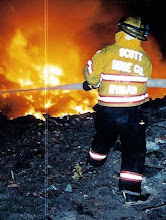
The changing of the season and the leaves falling from the trees reminded me of an experience I had years ago. Initially it came in as a small brush fire. The middle of the night dispatch was accurate as far as it went. I rode the left well of the wagon as we made our way down New Hampshire Avenue, the siren needed only infrequently at this hour with little traffic to impede us.

As we made the left hand turn onto the side street, I could see the column of flames in the air. Not typically what you see from a brush fire, but it was obviously coming from the wooded section near the edge of the neighborhood, so I didn’t think much of it. Another left onto the dead end roadway, and we were there.

There was definitely a brush fire. Unfortunately, the center of the burning brush and leaves included a van, fully involved. At least the column of fire in the night sky was now explained.

I dismounted and grabbed the nozzle of the inch and a half trash line from the running board, and started making the stretch toward the fire. Paulie, one of the career guys, flaked the line out behind me. The driver put the pump in gear and charged the line. I opened the nozzle and moved in toward the burning van, killing the burning brush in front of us as I went.

Reaching the van, I directed the nozzle into the interior, sweeping the stream across the ceiling then whipping the nob around. The fire darkened and seemingly went out inside the vehicle, but looking down, it was now shooting out from under the van onto my boots and lower legs. It got my attention.

Backing up a couple of feet, I swept the underside of the van with the stream. Now the fire flared back up inside the vehicle. Paulie left to go back to the Engine and pull another line, while I continued playing ping pong with the fire.

He returned with the second hose and we worked the brush and van together. Moving toward the engine compartment, the stream hit one of the vans front wheels. Bright beautiful colored flames came off of it.

“Shit,” Paulie and I said simultaneously. It was magnesium, which was a bitch to put out with water. You typically used sand or a special extinguisher. We didn’t have either this night.

I looked behind me and saw that the engine officer, Lieutenant F, had seen the same thing. He had a length of three inch on his shoulder and the Humat valve in his hand as he humped toward the nearest hydrant. He knew the tank water alone on the Engine wasn’t going to cut it.

Paulie and I kept working the lines. We were trying to keep the fire underneath the van knocked down and away from the gas tank. The hydrant supply established, the lieutenant supervised and moved from line to line behind us. He was an old fashioned officer. No way was he calling for help for a small brush fire.

We attacked from two directions, hoping to end the table tennis match with the fire. I kept pushing it away from the gas tank while Paulie knocked it down in the van again. He could tell the gas tank made me nervous. I knew they seldom caused problems, but they also weren’t typically exposed to fire for this long.

“Don’t worry kid. If that tank goes we’ll be frigging heroes, and we won’t feel a thing,” Paulie laughed.

It lightened the mood, which was his purpose. Slowly we got control, and with the coarse straight stream, were even able to put out the mag wheels.

Then came the drudgery; draining and re-racking the hose. The sun began to rise by the time we were done. Back at the station, I collapsed into my bunk for a half hour or so until the day shift crew came in. Just the routine noise they made ruled out further sleep. Good thing I was only twenty and didn’t require much rest.

Yeah, the colorful fall leaves are a wonderful thing.